More Safety.
More Calm.
More Yourself.
Personally guided, at-home listening support for your nervous system.
For many people, the body never quite gets the message that the danger has passed. A quiet background hum of vigilance keeps running, even when everything around you is objectively fine. The Safe and Sound Protocol works on that signal from the bottom up. You listen to specially processed music at home, at your own pace, and your nervous system gets the chance to relearn what safety feels like.
✓ Cancel within 14 days — as long as the music hasn’t started yet
- Certified Unyte Provider
- 1,100+ guided online programs since 2010
- Clinical oversight by a Dutch-registered psychologist
- 85% report less anxiety (Unyte/iLs, 2024)
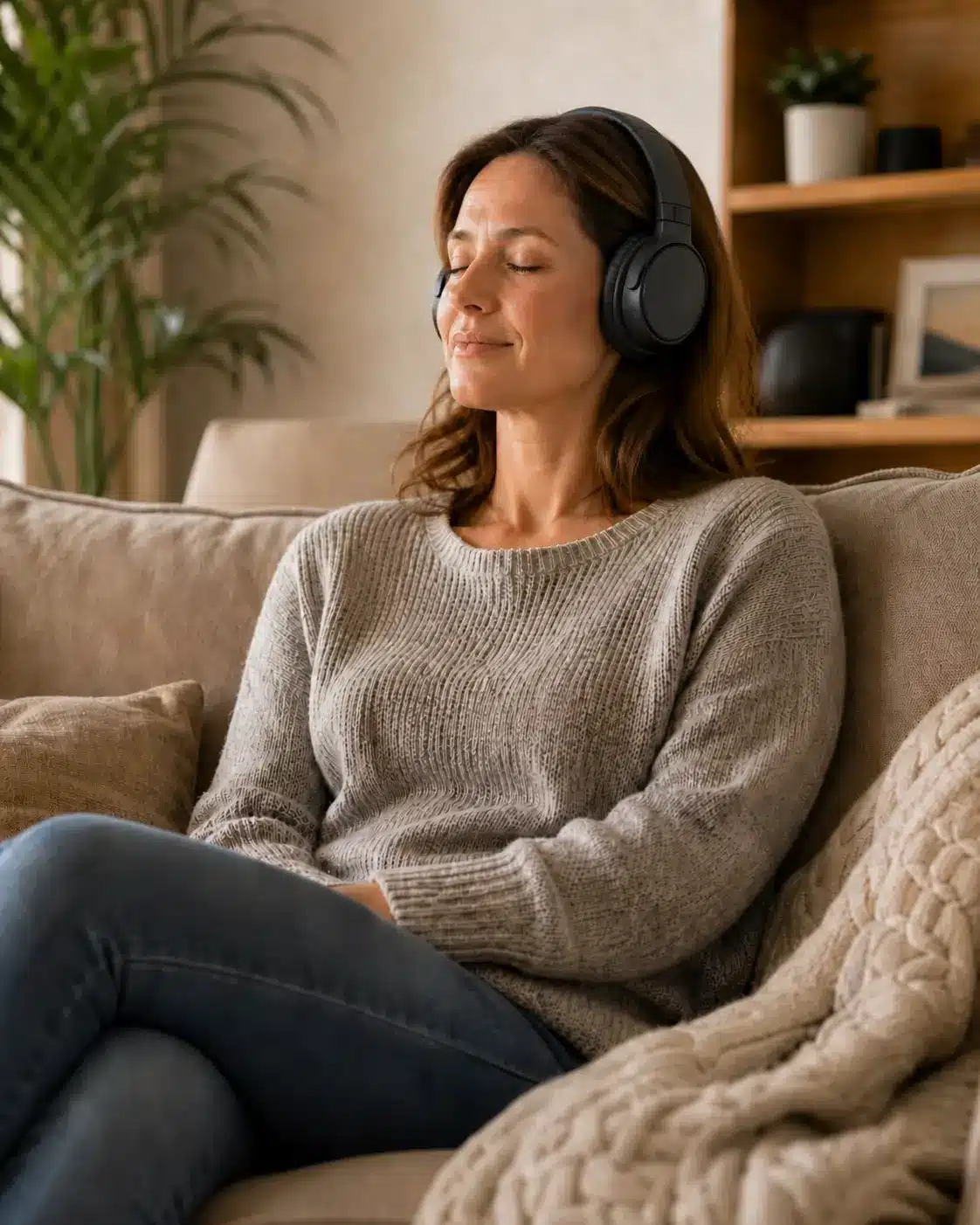
Who Uses the Safe and Sound Protocol
People reach for the SSP from many different places. Sometimes after years of high-functioning exhaustion. Sometimes after trauma therapy plateaued. Sometimes simply because the volume of life has become too loud.
- Anxiety & chronic stress
- PTSD & Complex PTSD (C-PTSD)
- ADHD — focus & emotional regulation
- Autism Spectrum Conditions (ASD/ASC)
- Sensory Processing challenges (SPD)
- Social anxiety
- Long COVID / vagal dysautonomia
- ME/CFS & chronic fatigue
- Burnout recovery
- Sleep difficulties
- Children with behavioral challenges
- Hypervigilance & freeze states
The SSP is also widely used as preparation for trauma therapy. When the nervous system has more room to regulate itself, EMDR tends to move faster, somatic work goes deeper, and cognitive approaches actually land. Many therapists recommend the SSP before or alongside their own treatment.
What Clients Notice After Listening
Real experiences from real people, shared with their permission. More experiences and longer case studies are on our experiences page.
“One of the first changes I noticed was in my thoughts. Even in the middle of an incredibly stressful season of life, I could access more regulated, open, curious thoughts. There was suddenly space between a trigger and my reaction. That pause has been a gift. The second change has been deeply personal. This protocol helped me move out of a long-standing freeze state that had affected my relationships for 17 years. I have been able to be present and emotionally connected in a way I had not experienced in nearly two decades.”
“I keep being amazed by the difference. The depression I had struggled with for almost 10 years is nearly completely gone. I sleep better and wake up rested, which had not happened in over 6 years. I feel more patient and calm. I do not have to act calm anymore. I actually feel it.”
“It has made a world of difference. For me, for my partner, even for our dog. Your support for the hypersensitive client was exactly right. I couldn’t go beyond 10 seconds for quite a while. Then suddenly my system responded and I could follow the full schedule. I intend to continue every year.”
“I noticed a mild response already on the very first one-minute day, like a small inner stirring. After just a couple of days I was already a little calmer, and some persistent digestion issues seemed noticeably better. Small, consistent increases worked well for me. My body seems a bit more resilient now.”
How the Safe and Sound Protocol Works
Unlike talk therapy, the SSP works on a layer of the nervous system that sits underneath thinking. The brainstem. The auditory pathway. The vagal pathways that govern safety and connection. No talking required. No insight required. You just listen.
- Specially filtered music meets your middle earThe SSP uses patented music processed to emphasize frequencies between 500 and 4,000 Hz — the range of a calm human voice. The voice of a lullaby. The voice of someone you trust.
- Your middle ear muscles get a gentle workoutThe stapedius and tensor tympani are tiny muscles inside your middle ear, often described as a remote control for your nervous system. The SSP gradually trains them to pick up cues of safety with more speed and precision.
- A safety signal travels through the brainstemThe trained middle ear muscles send a signal up the auditory pathway to the ventral vagal complex — the most recently evolved branch of the vagus nerve, associated with social engagement, learning, and felt safety.
- Your autonomic nervous system begins to shiftHeart rate variability can rise. The Social Engagement System comes back online. The constant background hum of fight-or-flight quiets down. Not through willpower. Through biology.
Why “bottom-up” changes everything
When your nervous system is locked in defense, your prefrontal cortex goes partially offline. That is your center of insight, language, and logic. Talk therapy, mindfulness, and cognitive tools can only land when your system is safe enough to receive them. The SSP works on creating that ground floor of safety first.
Why you may feel more socially connected
The SSP doesn’t just train calm. It also restores your capacity to feel safe with other people.
Dr. Stephen Porges discovered that our nervous system sends and receives signals of social safety through six interconnected functions — from our facial expressions to the way we hear voices. He called this the Social Engagement System.
When chronic stress, trauma, or overwhelm suppresses this system, social situations become exhausting. Eye contact feels overwhelming. Self-regulation around others becomes difficult — even when you deeply want to connect.
The SSP uses filtered vocal music to train the middle ear muscles — exactly the muscles involved in distinguishing human voices from background noise. As those muscles grow stronger, the nervous system automatically re-engages the broader Social Engagement System. Not through exercises. Through biology.
- You understand tone of voice and emotions more easily
- Social situations cost less energy
- You feel safer around others — and within yourself
- Eye contact becomes less overwhelming
- You co-regulate more naturally with the people around you
- Conversations feel more natural — less masking, more presence
The three SSP programs
SSP Connect
A gentle introduction with unfiltered music. Prepares your nervous system for what follows. Especially helpful if you are highly sensitive or want to ease in slowly.
~1 hour · Optional but recommendedSSP Core
The active neural program. Gradually filtered music takes your middle ear muscles through their full training. This is where the deeper shift tends to happen.
~5 hours · Spread over days or weeksSSP Balance
The integration phase. Lighter filtering helps maintain and deepen Core results. You can return to this whenever life starts asking more of your system again.
Ongoing · As neededThe “Day 4 Effect” — something you won’t read anywhere else
Around day 4 of SSP Core, we regularly notice a brief window of heightened sensitivity. Sometimes irritability. Sometimes emotional rawness. This is not a setback. It is your auditory system recalibrating. Two days later, most clients report the deepest calm they have felt in years. We prepare every client for this in advance.
A program with a reach that goes far beyond “feeling a little calmer”
Five hours of listening. An impact that touches far more than stress levels.
Sensory processing
- Reduce sound sensitivity
- Improve auditory processing
- Higher sensory tolerance
Behavior & emotion
- Better behavioral regulation
- More emotional balance
- Deeper capacity to relax
Connection
- Greater social ease
- Better connection with yourself
- More authentic contact with others
Safety
- Support neuroception (felt sense of safety)
- Deeper sense of safety from within
- Body and mind in rest and ease
Energy & recovery
- Better sleep
- More energy during the day
- Less chronic fatigue
Synergy
- Strengthens EMDR and somatic work
- Improves therapy readiness
- HRV and heart coherence
What Actually Happens When People Listen
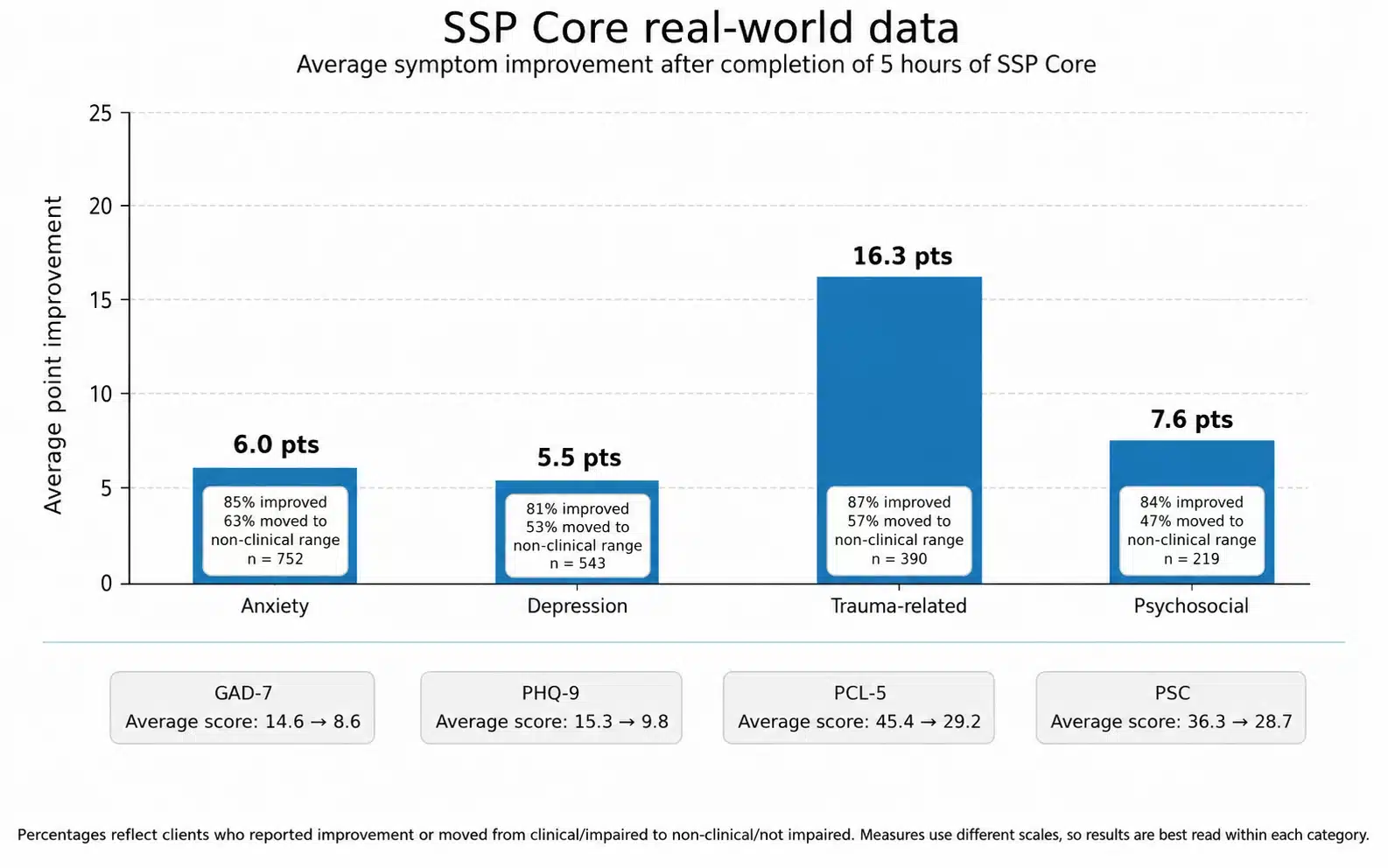
These are not survey numbers. They are validated clinical scale outcomes collected from real clients who completed the Safe and Sound Protocol. All figures represent self-reported improvements. Individual results vary.
The numbers behind the change
Anxiety scores dropped an average of 6.0 points on the GAD-7 (from 14.6 to 8.6). Trauma symptoms improved by 16.3 points on the PCL-5 (from 45.4 to 29.2). Depression scores dropped 5.5 points on the PHQ-9 (from 15.3 to 9.8). More than half of clients who started in the clinical range moved into the non-clinical range. After just 5 hours of listening. In 2024, the U.S. Department of Defense awarded nearly $3.8 million for a double-blind RCT on SSP for PTSD. Individual results vary.
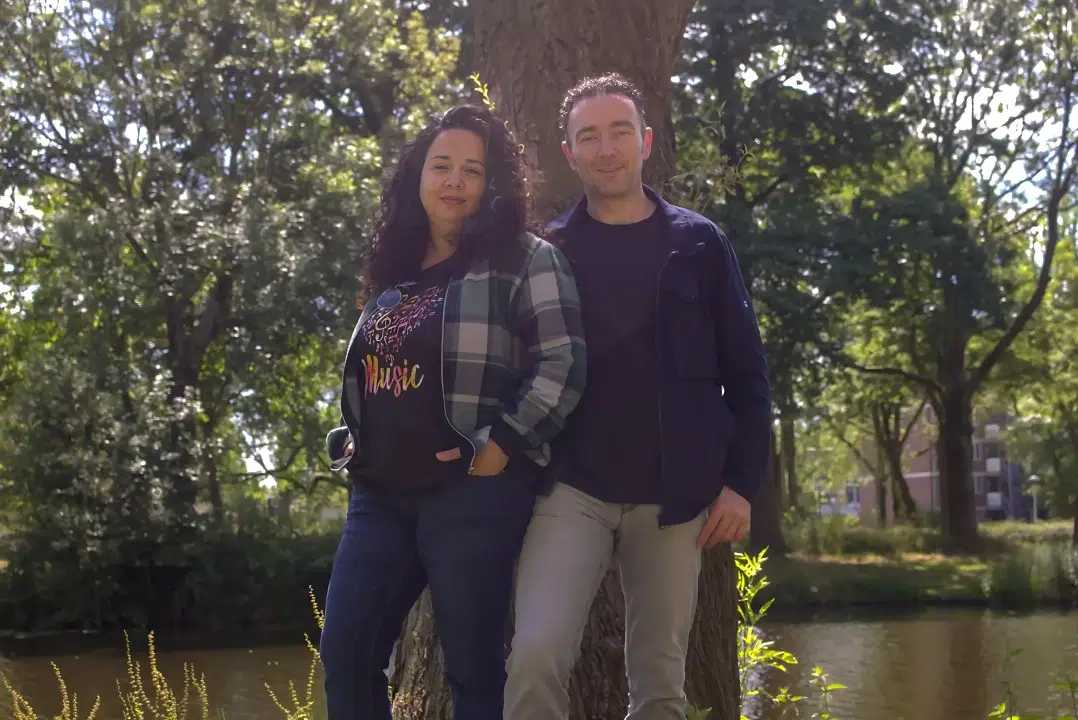
1,100+ Guided Programs Since 2010. Every Single One Online. Every Single One Real.
-
Certified Unyte Health Provider Official SSP and RRP certification by Unyte/iLs, the organization that works directly with Dr. Stephen Porges to deliver the protocol worldwide.
-
Clinical oversight by a Dutch-registered psychologist (GZ-psycholoog) Shahera el Katib holds GZ-psycholoog registration in the Netherlands (BIG: 89919609425), the Dutch state registry for licensed health professionals. Every program operates under her professional oversight at Dutch clinical standards.
-
Online experience since 2010 — serving U.S. clients remotely 14+ years in mental and behavioral health care. 5+ years specifically in online SSP delivery. Our remote protocol has been refined for sensitive nervous systems across the US, UK, Netherlands, Australia, and beyond.
-
Individual written intake — for every client, every time We read every intake carefully. What you share shapes your starting duration, your pathway order, and how often we check in. Every program is different, because every nervous system is different.
 Officially certified Unyte Health Provider — Safe and Sound Protocol (SSP) and Rest and Restore Protocol (RRP).
Your home is your safe place. Our entire protocol is built around that.
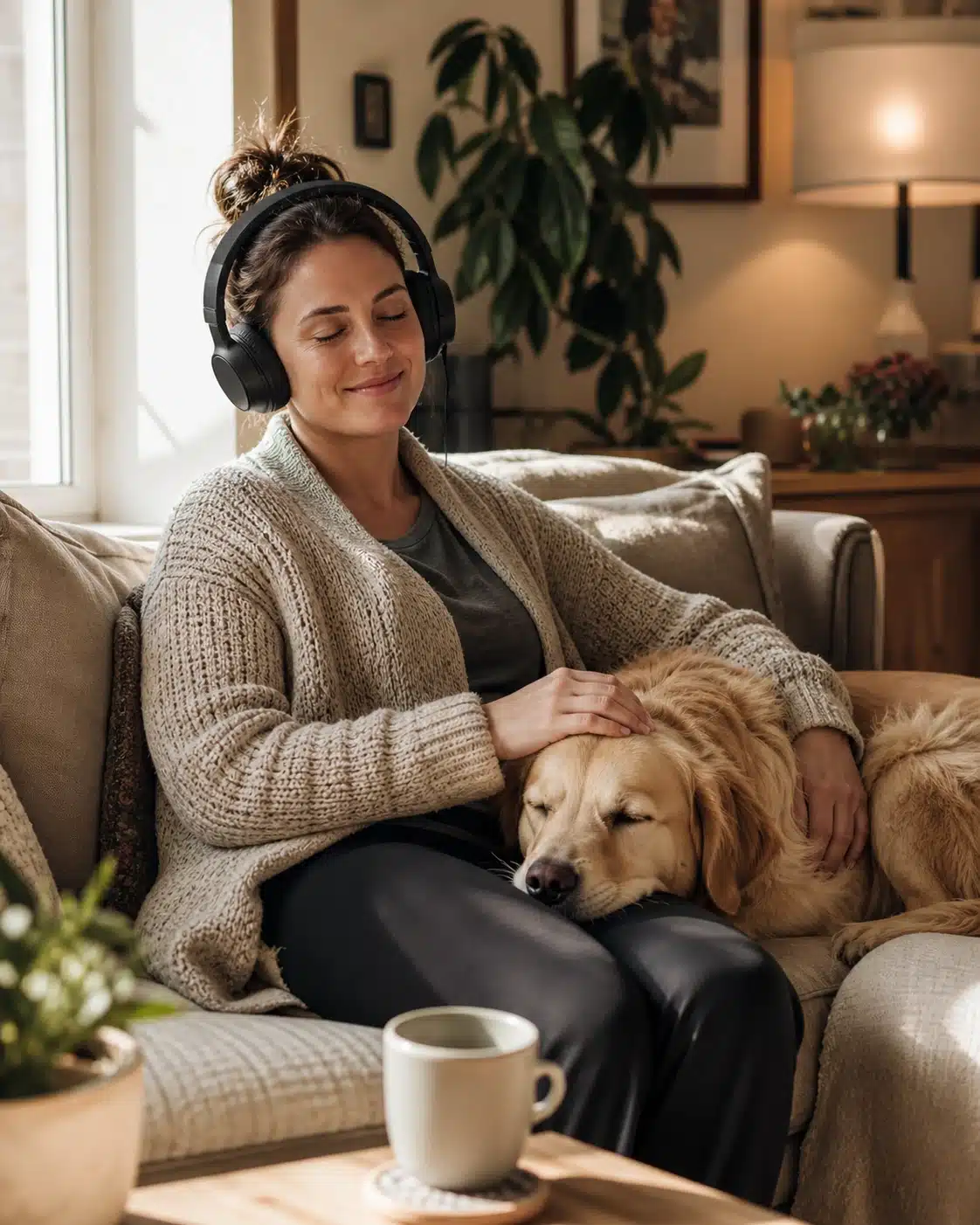
Available remotely from the Netherlands. No visit required.
We are based in Utrecht, Netherlands, and serve U.S. clients entirely online. Here is what that looks like in practice:
- Delivered through the Unyte app, available in the U.S.
- No video sessions required
- No diagnosis required to start
- No U.S. insurance billing
- Payment in USD ($300)
- All support provided in English
- GDPR-compliant data handling (European standards)
- 14-day cancellation window (music not yet started)
Start when you are ready, not when the system allows it
There is no waitlist, no referral needed, and no pre-authorization. You sign up, complete your intake, and begin. On your timeline. In your own home.
What happens after you sign up?
- You sign upYou receive your order confirmation and access to the next step right away.
- You receive our written intake formComplete it at your own pace. No rush. No deadline.
- We build your personalized listening scheduleBased on your intake: your starting duration, pathway order, and notes specific to your nervous system.
- You download the free Unyte appAvailable on phone, tablet, or laptop. A regular pair of stereo headphones is all you need.
- You listen at home, in your own safe spaceOn your couch. In your chair. No camera. No scheduled appointments.
- You send us an optional written updateAfter sessions, you can message us. What you notice. How you feel. No obligation, just an open door.
- We respond and adjust as neededIn writing, in English, professionally. For all 12 months.
How does this fit into your life?
- 5–15 minutes per session on average Many clients listen in short, gentle sessions. No long blocks required.
- No fixed daily commitment Pause whenever your nervous system asks for it. The 12 months are yours.
- Listen during your natural wind-down Evenings, after work, on your couch with a blanket. The setting is part of the therapy.
- Micro-dosing protocol We never start anyone with 60-minute sessions. Based on your intake, your first session might be 10 seconds. Slow is always faster in nervous system work.
- Written support, not surveillance We do not watch you on video. Our support is asynchronous, professional, available. Without the pressure of a camera or fixed appointments.
- Your environment as part of the therapy Your chair. Your blanket. Your pets. These are ventral anchors: signals of safety that help your nervous system receive the SSP input as non-threatening.
- Depth through repetition With 12 months of access, you can return to the program whenever your system is ready. Each pass tends to deepen the change. Our longest-running clients have done 5+ rounds.
How we do it differently
Many SSP providers bill per session. We chose a different path. Nervous system regulation takes time and repetition. It cannot be compressed into a handful of appointments.
| Aspect | Session-based offering | SSP with SoundTherapy |
|---|---|---|
| Intake | Usually general history-focused | Thorough written intake, tailored to your nervous system, sensitivities, and daily life |
| Protocol | Standard for everyone | Micro-dosed and adapted to your system |
| Support | During sessions only | Written support in English, throughout 12 months |
| Video required | Often | No. Low-demand, autonomy-based |
| Environment | Clinical setting or fixed video call | Your home, your safe space |
| Pricing model | Per-session billing | One price, 12 months access |
When high performers discover the SSP
Not everyone who comes to the SSP is in crisis. A growing part of our clientele are executives, athletes, founders, and professionals who function brilliantly under pressure and then collapse at home. The off-switch is broken. For this group, the SSP is less about repair and more about investing in long-term cognitive capacity: the bandwidth to stay focused, to recover from stress, to think clearly when everything is moving fast. In elite sport, this ability is called Autonomic Agility. Not a relaxation technique. A performance skill.
Everything Included. One Price. One Year.
No hidden fees. No per-session billing. Just you, the music, and time for your system to heal.
That works out to about $25 a month, billed once annually at $300.
* Cancel within 14 days — as long as the music hasn’t started yet.
✓ Cancel within 14 days — as long as the music hasn’t started yet
After signing up, you receive your personal intake form. Based on what you share, we build your listening schedule. You download the Unyte app and start when you are ready. At home. With regular stereo headphones. During your 12 months, you can repeat the protocol as many times as your system asks for. Each round tends to deepen the effect.
Maybe this is your moment to begin
You don’t have to do anything. Just listen.
Sign up and you receive your personal intake form. Complete it whenever you are ready. No rush. No pressure. We take it from there.
✓ Cancel within 14 days — as long as the music hasn’t started yet
What Clients of SoundTherapy Say
Experiences from our own programs, shared with permission. All names have been changed for privacy.
“Within 2 weeks, our son was willing to try new things: slides, climbing, playing with friends. By 4 weeks in, he started asking for hugs. The occupational therapist is so impressed with his progress that she wants to learn about SSP herself. My husband thought this was a silly idea. Now that he has seen the change, he is a complete believer.”
“I noticed I no longer had the sweaty palms, the sick feeling in my stomach, or the heat rising in social situations. My boyfriend called me ‘a different person.’ At work, on public transit, in restaurants. The anxiety was simply gone. I now make conversation easily with strangers, which I had never dared before.”
“Everyone with ME/CFS should know about this. After lying down almost completely since October, I can do small exercises again: qigong, a bit of yoga. My nervous system has clearly improved. It is bringing me back to life.”
“I feel like my senses are coming back online. It is almost as if I did not realize how dim everything had become. I am noticing things I have never noticed before. I am calmer. I sleep deeply. My body feels like mine again.”
Your Questions, Answered
What is the Safe and Sound Protocol?
The Safe and Sound Protocol (SSP) is a non-invasive, 5-hour listening program developed by Dr. Stephen Porges, based on his Polyvagal Theory. It uses specially filtered vocal music to gently train the middle ear muscles and support the nervous system toward more regulation and felt safety.
You can do it entirely at home, at your own pace, spread over as many days as your system needs.
Can I cancel within 14 days?
Yes. You can cancel within 14 days of purchase, as long as the music hasn’t started yet. Filled in your intake but haven’t listened? The cancellation window still applies. Send us a message and we will process your refund promptly.
Is the SSP covered by insurance or my HSA/FSA?
We do not bill U.S. insurance, neither private nor government plans. The SSP through SoundTherapy is a self-pay listening program delivered digitally from the Netherlands. No diagnosis code is required or provided.
We cannot guarantee HSA/FSA eligibility, since it depends on your specific plan. Some clients have successfully submitted receipts to their HSA/FSA administrator. We can provide an itemized invoice after purchase. Please check with your plan administrator before purchasing if reimbursement is important to your decision. We do not provide Superbills.
Is it safe to do the SSP remotely, without in-person supervision?
Yes. For many clients the home setting is therapeutically preferable. You are not performing calmness for a therapist. You are in your own space, with your own anchors, without the social demands of a clinical setting.
Our remote protocol includes a thorough written intake, a personalized listening schedule, and written support throughout. We have refined this over 1,100+ online programs.
What does $300 include?
$300 gives you 12 months of full access to all three SSP programs (Connect, Core, and Balance) in all available musical versions, via the Unyte app. Included: personal written intake · your customized listening schedule · written support in English throughout your 12 months · our bonus Polyvagal course (entirely optional).
No hidden fees. No per-session billing. You can listen once or repeat the protocol multiple times. Each repetition tends to deepen the effect.
What headphones do I need?
Always use over-ear stereo headphones: a pair where the ear cups fully cover your ears. In-ear earbuds are not suitable for the SSP.
Wired or wireless makes no difference. Active Noise Cancelling (ANC) headphones are fine to use, as long as you fully disable the ANC and any other sound processing during your session.
Do I need a diagnosis to start?
No. You do not need a diagnosis, a referral, or approval from a healthcare provider to purchase and use the SSP. We do not require or process diagnostic information.
If you are currently under care for a serious mental health condition, please let your provider know before starting. And do mention it in your intake form so we can support you appropriately.
Why a Dutch provider for U.S. clients?
The SSP is a standardized protocol delivered through the Unyte app. The music, the filtering, the structure are identical wherever the program is offered. What differs is who guides you and how.
Our 1,100+ guided programs since 2010 have given us a depth of experience with sensitive nervous systems that is rare to find. Our written, asynchronous model removes the friction of fixed appointments and video sessions. There is no insurance chain, no waitlist, no pre-authorization. And EU data protection (GDPR) is among the strictest in the world.
The trade-off: this is not U.S.-licensed psychotherapy and we cannot bill U.S. insurance. If those are essential, the SSP is also offered by Unyte-certified providers based in the U.S.
How does the SSP actually work?
The SSP filters music to emphasize frequencies between 500 and 4,000 Hz, the natural range of a calm human voice. This invites the middle ear muscles to actively tune in, which sends a signal up the auditory pathway through the brainstem to the ventral vagal complex — associated with safety, social connection, and regulation.
Think of it as gentle physical therapy for your nervous system’s safety signal. You just listen. The biology does its own work.
How long does it take to notice changes?
Many clients notice something during or after their first few sessions. A subtle shift in energy. Easier sleep. Less emotional reactivity. Real-world data shows 85% of clients report improved anxiety symptoms after completing the 5-hour Core program (Unyte/iLs, 2024). Individual results vary.
For deeper change, we recommend completing the protocol at least twice. Your 12-month access is designed for that.
What if I am highly sensitive or have found SSP too intense before?
This is exactly what we specialize in. During your intake we get a sense of your nervous system’s starting tolerance. For highly sensitive clients, we sometimes begin with sessions of 10 seconds. Seconds, not minutes.
Our Micro-Dosing Protocol, developed over 200+ programs with highly sensitive clients, lets the nervous system adapt at its own pace. Slow really is faster in nervous system work.
Can I combine the SSP with my current therapy?
In most cases, yes. Many therapists use the SSP as preparation for or alongside EMDR, somatic therapy, or CBT. The SSP may help your nervous system reach a state where other interventions land more effectively. Please let your current provider know you are starting the SSP. We can provide a brief information sheet for therapists on request.
What if I skip a day or cannot keep up?
No problem. That is exactly why you have 12 months of access. Send us a message if you get stuck or want to pause. We will adjust your schedule and make sure your program feels right, even if it goes slower than expected.
Is the SSP safe for my child?
Yes. The SSP is widely used with children for ASD/ASC, ADHD, sensory sensitivities, attachment challenges, and behavioral difficulties. Real-world data shows 84% of children showed psychosocial improvement (PSC, n=219). For children, we create an adapted protocol with shorter sessions and gradual progression. Parents receive clear guidance on how to make listening sessions relaxed and calm.
Is the SSP evidence-based?
The SSP rests on 40+ years of peer-reviewed research in autonomic neuroscience by Dr. Stephen Porges. The evidence base includes two randomized controlled trials (RCTs) with a combined 146 children through the Listening Project Protocol, the direct scientific predecessor to the SSP.
Real-world data (Unyte/iLs, 2024): 85% of 752 clients reported reduced anxiety (GAD-7); 87% of 390 clients improved on the PCL-5; 81% of 543 clients reported reduced depression (PHQ-9). All figures represent self-reported improvements. Individual results vary.
Ready to begin?
Your nervous system does not need more willpower. It needs safety.
Sign up, complete your intake at your own pace, and we take it from there. Written support in English, clinical oversight, 12 months of access.
✓ Cancel within 14 days — as long as the music hasn’t started yet
The Safe and Sound Protocol:
From Brainstem to Gene Expression
Nine chapters. Thirty-one peer-reviewed sources. Seven documented case studies, including a psychiatric inpatient facility, foster care, elite sport, and a rescue dog named Daisy.
✿ Transparency & Honesty
A few things we believe are important to tell you upfront.
Not an FDA-approved medical treatment
The Safe and Sound Protocol is a guided listening program. It is not an FDA-approved medical treatment, not U.S.-licensed psychotherapy, and does not replace care from a licensed U.S. healthcare provider. Many people use it alongside professional care — and that is exactly what it is designed for.
When to consult your healthcare provider first
If you are in acute crisis, experiencing psychosis, having active suicidal thoughts, living with unmanaged epilepsy, severe dissociation, or an unsafe home environment. Please reach out to us before signing up. We will think through together what makes sense for you right now.
You always receive a full refund if the intake shows the SSP is not the right fit for you at this time.
For sensitive nervous systems
We start slowly. Shorter sessions, more pauses, a gentler build. Your pace is part of the program. There is no schedule you have to meet. Not sure? Send us a short message — honest advice, no pressure.
Experiences are personal
The stories on this page come from our own clients, shared with permission. All names have been changed for privacy. How your nervous system responds is unique. Client experiences are not a guarantee of results. All outcome data represents self-reported improvements on validated clinical scales. Individual results vary.
Not sure if the SSP is right for you? Send us your situation → We listen, think it through with you, and give honest advice.
Scientific References & Sources
The Safe and Sound Protocol is grounded in peer-reviewed neuroscience. The following sources support the claims and clinical basis on this page.
Polyvagal Theory — Foundational Research
- Porges, S.W. (1994). Orienting in a defensive world: Polyvagal Theory. Psychophysiology, 32(4), 301–318. polyvagalinstitute.org
- Porges, S.W. (2011). The Polyvagal Theory. Norton & Company.
- Porges, S.W., Bailey, R., & Dugard, J. (2023). Appeasement: Replacing Stockholm Syndrome as a definition of a survival strategy. European Journal of Psychotraumatology, 14(1). tandfonline.com
- Polyvagal theory: current status, clinical applications, and future directions. PMC, 2025. pmc.ncbi.nlm.nih.gov
- When a critique becomes untenable: a scholarly response to Grossman et al.’s evaluation of Polyvagal Theory. PMC, 2026. pmc.ncbi.nlm.nih.gov
SSP — Clinical & Scientific Basis
- Neurophysiological background for the Safe & Sound Protocol. Unyte. SSPScience.pdf
- Safe and Sound Protocol: A practical application of Polyvagal Theory. Action Trauma. actiontrauma.com
- Unyte / iLs Real-World Data Report (2024). GAD-7, PHQ-9, PCL-5, PSC. integratedlistening.com
- Harnessing non-invasive vagal neuromodulation: HRV biofeedback and SSP. Spandidos Publications, 2025. spandidos-publications.com
Validated Clinical Measurement Tools
- GAD-7: Spitzer, R.L. et al. (2006). Archives of Internal Medicine, 166(10), 1092–1097.
- PHQ-9: Kroenke, K. et al. (2001). Journal of General Internal Medicine, 16(9), 606–613.
- PCL-5: Weathers, F.W. et al. (2013). National Center for PTSD.
- PSC: Jellinek, M.S. et al. (1988). Archives of Pediatrics & Adolescent Medicine, 142(10), 1110–1116.
Psychoneuroimmunology & Epigenetics
- From Molecules to Meaning: Neuropeptides, Sociostasis, and the Brain–Heart Axis. MDPI, 2026. mdpi.com
- Epigenetics and Psychoneuroimmunology. PMC / NIH. pmc.ncbi.nlm.nih.gov
- HRV biofeedback and SSP for cardiovascular and autonomic regulation. PMC, 2025. pmc.ncbi.nlm.nih.gov
Scientific references are provided for informational and transparency purposes. The SSP is a non-invasive listening program and not a substitute for professional medical or psychological care.